

Pricing
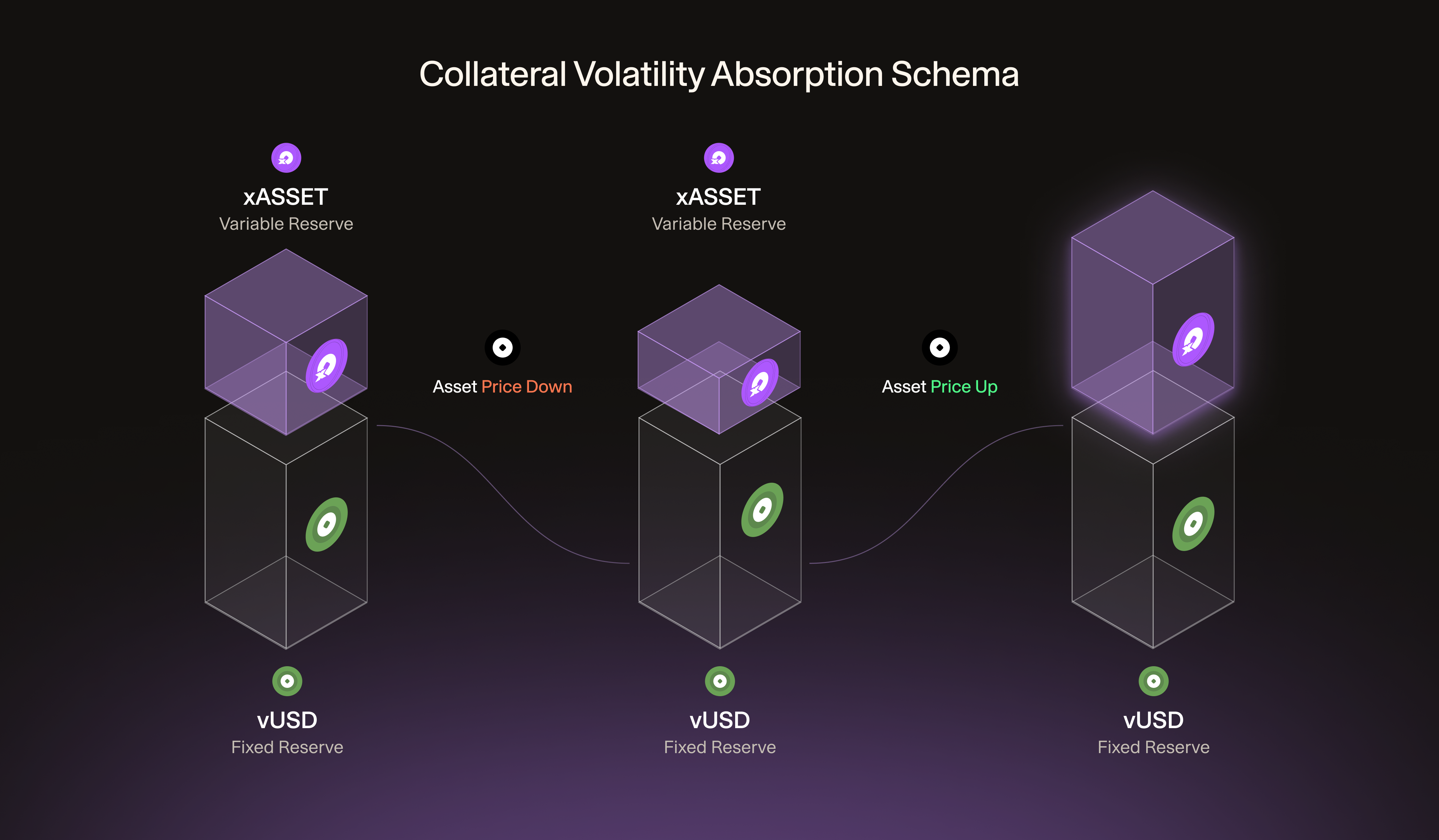
The price of any xASSET is calculated from the variable reserve, the excess value not backing the virtual stablecoin: As the underlying asset appreciates, the xASSET price increases with effective leverage. If the asset price drops, the xASSET absorbs the loss, maintaining the vUSD peg.Example: xSOL Price Adjustment
Example: xSOL Price Adjustment
- Initial Scenario
- SOL Price Increases
- SOL Price Drops
Effective Leverage
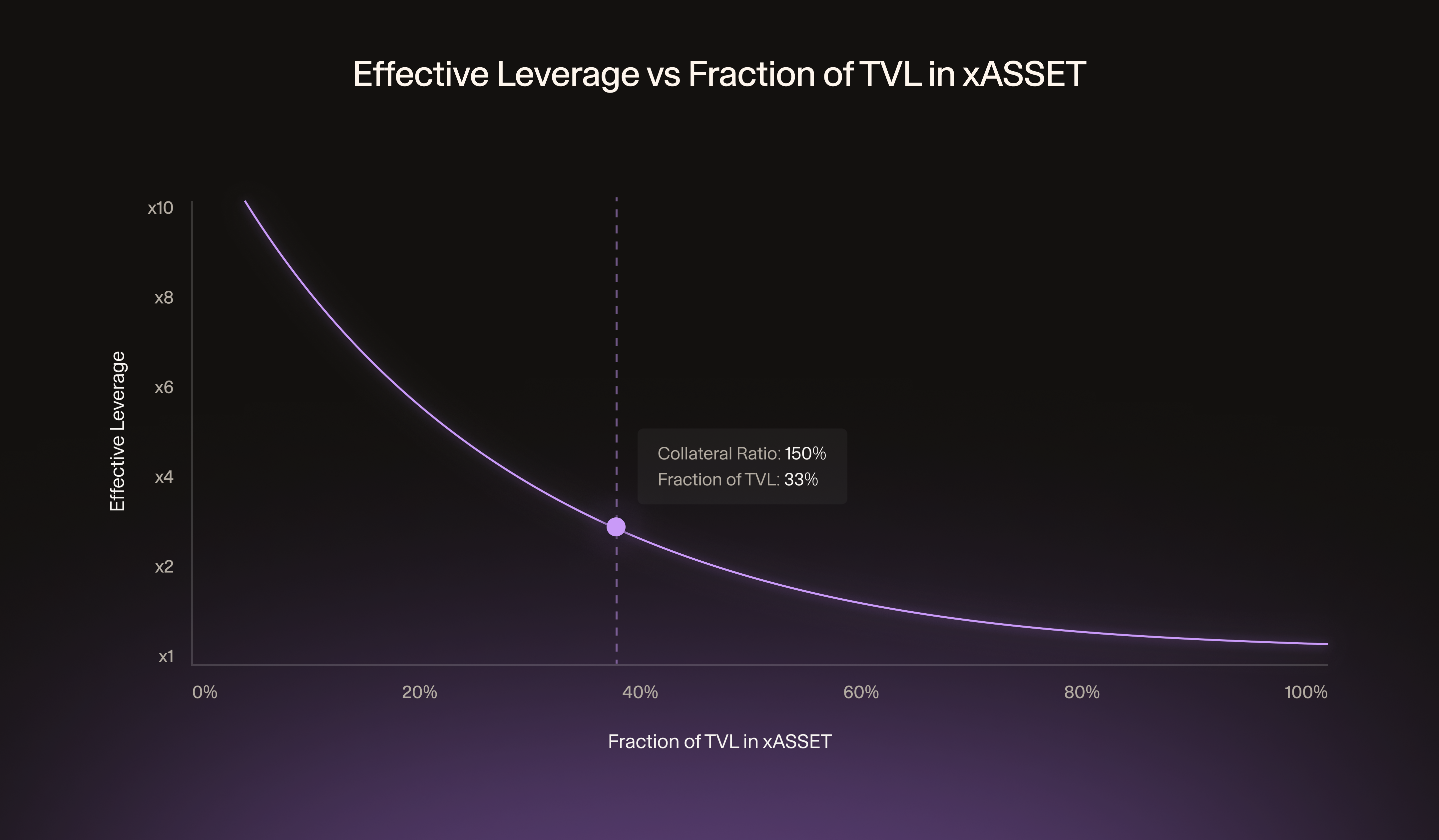
Effective leverage reflects an xASSET token’s amplified exposure to its underlying asset at a point in time: Leverage fluctuates dynamically with protocol activity:- Increases when vUSD is minted or xASSET is redeemed
- Decreases when vUSD is burned or xASSET is minted
Example: xSOL Leverage Dynamics
Example: xSOL Leverage Dynamics
- Initial Scenario
- After vUSDSOL Minting
- After vUSDSOL Redemption
xSOL: Free Leverage
xSOL benefits from the SOL pool’s staking yield. Since LSTs generate native staking rewards, this yield flows to the protocol and no cost is charged to xSOL holders. Leverage is effectively free from ongoing costs besides the forfeited yield. The one exception is a high collateral ratio. Above 165% CR, the protocol harvests a multiple of the LST yield, and xSOL holders pay the amount above 1×. See the borrow rate curve.xBTC: Borrow Rate Leverage
BTC doesn’t generate native yield. As such the protocol exacts a configurable borrow rate on the BTC pool, paid by xBTC holders through gradual NAV reduction. The charge is based on the xBTC market cap, so the effective rate on leveraged exposure rises as leverage falls. The rate also follows the pool’s CR. It stays at the base rate in the Neutral zone, rises linearly above 165% CR to a capped 2× the base rate at 175% CR, and pauses below 135% CR. See the borrow rate curve for details.Fee Structure
xASSET minting and redemption are each subject to a flat, configurable fee per pool. In extreme market conditions, fees may be temporarily adjusted for risk management purposes to incentivize healthy protocol behavior. See risk-management for details.Risk: Volatility Decay
xASSET value is path-dependent. Large price swings in both directions erode value because leverage amplifies both gains and losses. Example:- SOL is at $100, xSOL is at $100 with 2x leverage
- SOL drops 20% to $80; xSOL drops 40% to $60
- SOL recovers back to $100, but xSOL only recovers to $90, not $100