

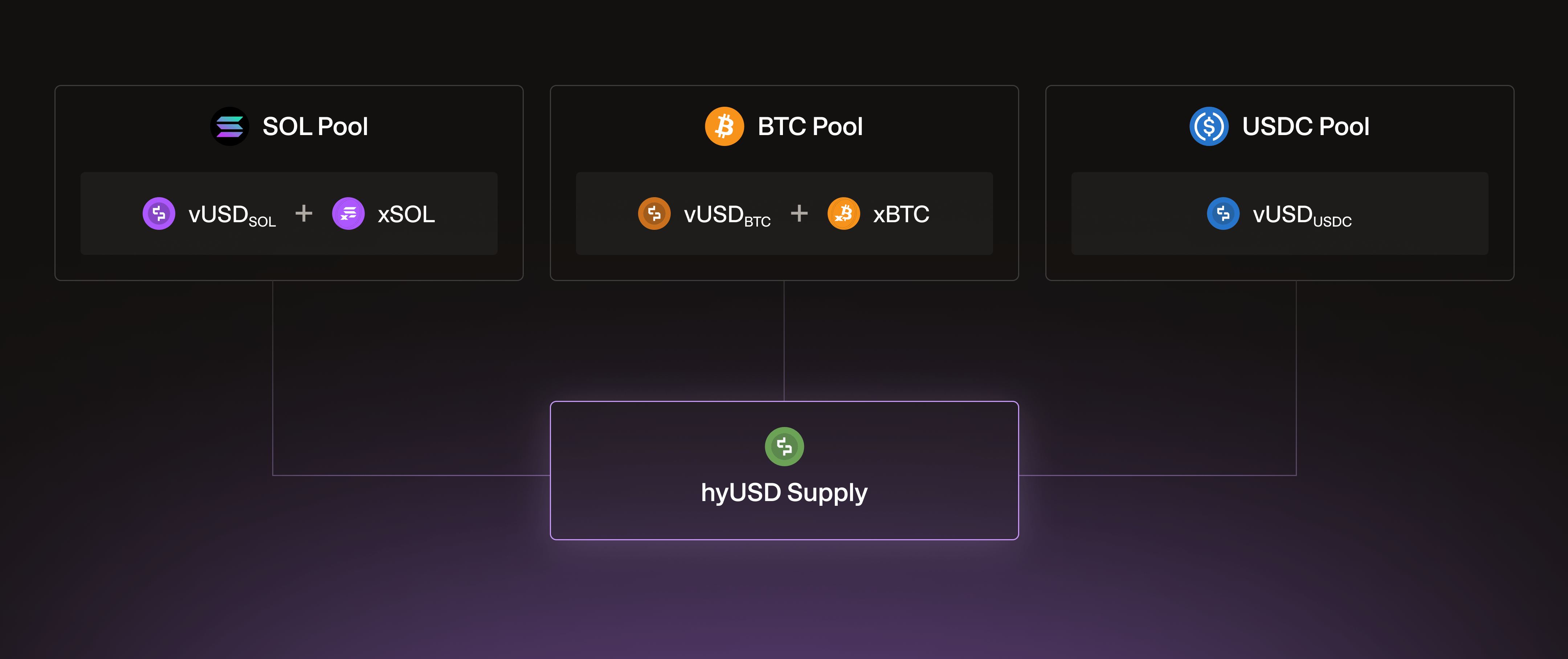
hyUSD Master Equation
Given the set C of supported collateral assets, the hyUSD supply is defined as: In simpler terms, hyUSD is backed 1:1 by the sum of all virtual stablecoins when individual collateral ratios are healthy above 100%.Collateral Pools
Each collateral pool operates independently with its own assets, collateral ratio, risk parameters, and yield mechanism.SOL Pool
The SOL collateral pool consists of Liquid Staking Tokens (LSTs) supported in Hylo’s LST registry, currently consisting of jitoSOL and hyloSOL. The total SOL in the pool at any given time is defined as the sum across the set of supported LSTs L: Pricing: Hylo uses true LST pricing via Sanctum, calculating LST value based on actual SOL in each stake pool. The Pyth SOL/USD oracle then converts SOL to USD. Yield: LSTs generate native staking yield from validator rewards. This yield flows to hyUSD stakers and protocol revenue, making leverage effectively free for xSOL holders while the pool’s CR is in the Neutral zone. Above 165% CR, the borrow rate curve scales the harvested yield, and xSOL holders pay the excess.BTC Pool
The BTC collateral pool consists of cbBTC, backed 1:1 by real Bitcoin in Coinbase’s institutional grade custody. Pricing: Pyth BTC/USD price oracle. Yield: BTC doesn’t generate native yield. The protocol charges a configurable borrow rate on the BTC pool, paid by xBTC holders through gradual NAV reduction. The borrow rate is harvested once per epoch and distributed to Earn Pool depositors and protocol revenue. The charge is based on the xBTC market cap, so the effective rate on a holder’s leveraged exposure rises as effective leverage falls. The rate also moves with the pool’s CR, as described in the borrow rate curve.HYPE Pool
The HYPE collateral pool consists of HYPE on Solana. Pricing: Pyth HYPE/USD price oracle. Yield: Like BTC, HYPE doesn’t generate native yield in the pool. xHYPE holders pay a borrow rate with the same mechanism as xBTC.USDC Pool
Hylo V1 intentionally limited its hyUSD minting capacity so as to not over-leverage the xSOL trade. In Hylo V2, hyUSD becomes infinitely scalable with the introduction of a USDC pool. USDC does not have a leveraged component and is simply defined as a virtual stablecoin. The protocol values USDC at $1, so USDC and hyUSD convert one for one. USDC routes are only available while the Pyth USDC/USD price stays within a small configured tolerance of $1. The USDC pool serves two roles:- Direct hyUSD access: Users can mint and redeem hyUSD with USDC at flat fees. The mint fee and the redeem fee are configured separately, currently 0% to mint and 0.2% to redeem.
- Rebalancing counterparty: The USDC pool is the other side of all collateral rebalancing routes, receiving USDC from deleveraging sales or deploying USDC to re-leverage volatile pools as their CR moves into extreme zones.
Borrow Rate Curve
The borrow rate is not fixed. Each pool’s rate follows a curve driven by that pool’s CR, using the same rebalance zones as the rest of the protocol.
The base and ceiling rates are configurable per pool.
What about xSOL? xSOL has no base borrow rate. Instead, the same CR multiplier applies to the LST yield harvested each epoch. In the Neutral zone the multiplier is 1×, so the harvest equals the staking yield and xSOL leverage stays free. Above 165% CR the multiplier rises toward its ceiling, and the amount above 1× comes out of xSOL equity as a borrow rate.
Why this helps: When leverage demand is high, current yields may not attract enough eHYUSD deposits. This liquidity shortage raises the pool’s CR and leaves xASSETs with lower leverage than intended. Higher borrow rates increase eHYUSD yields, which encourages deposits when liquidity is most needed. More deposits restore leverage and bring the rate back down. These increases are expected to be occasional and short-lived for most xASSETs, depending on deposit activity and market conditions.