

High CR Pool
Low mint fee, and no redemptions above 150% CR. Attracts inflows, stops outflows.
Low CR Pool
No mints below 150% CR, and a low redeem fee. Stops inflows, attracts outflows.
Routing Schema
xASSET collateral flows cannot be directed since users want leveraged exposure to a specific asset. However, hyUSD flows can be directed. When a user wants hyUSD they are not concerned with which collateral pool backs it. Hylo employs a dynamic fee system to effectively route hyUSD mints and redemptions to and from the most optimal pool. By making it cheaper to mint hyUSD from healthier pools, the protocol naturally directs collateral where it’s needed. Vice versa on the redemption side, the least healthy pool will surface the lowest fee. The USDC pool has flat fees, so it sets the baseline that the volatile pools compete against, and it takes the flow when no volatile pool can. The DEX router (e.g. Titan, Jupiter) evaluates the proposed fee from each available pool and selects the cheapest path. In this example, the SOL pool’s high CR yields the lowest fee, so the router swaps the user’s input token to SOL LSTs and mints hyUSD through that pool.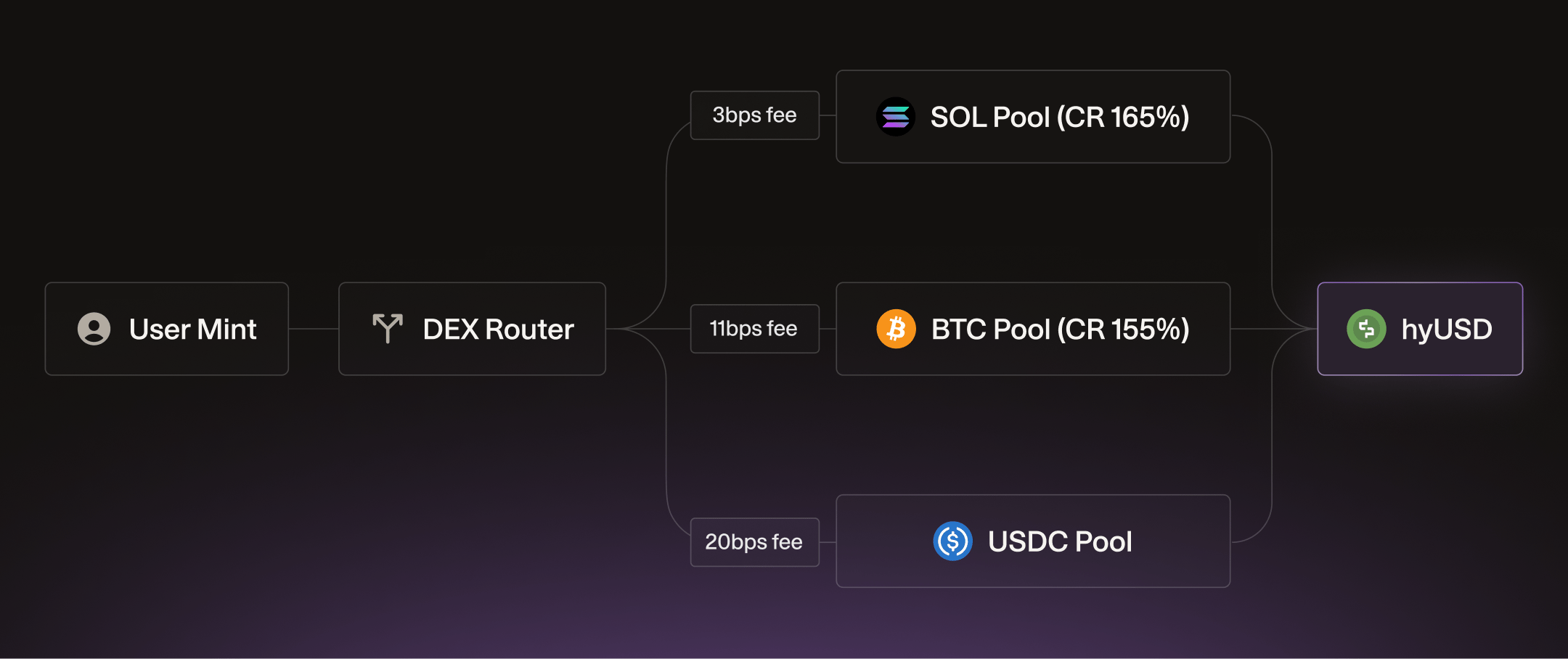
USDC Pool: Flat Fees
The USDC pool operates differently from standard collateral pools in that it acts as an overflow buffer for hyUSD demand. It applies a flat mint fee and a flat redeem fee, each configured separately and independent of CR. The mint fee is currently 0% and the redeem fee is 0.2%. On fee alone, the USDC pool is the cheapest mint route, below the volatile pools’ minimum fee. A router selects a volatile pool when the full path cost, including the swap into the deposit asset, is lower. The redeem fee matches the top of the volatile pools’ redeem fee curve. Redemptions therefore go to any pool below its target first, and the USDC pool pays out when no other pool offers a lower fee. USDC converts to hyUSD one for one, at $1. As a safeguard, USDC routes are only available while the Pyth USDC/USD price stays within a small configured tolerance of $1 (at most $0.001).Volatile Pools: Fee Curves
For volatile collateral pools (SOL, BTC, HYPE), Hylo uses two independent piecewise fee curves, one for minting and one for redemption. Each curve maps a pool’s collateral ratio to a fee percentage.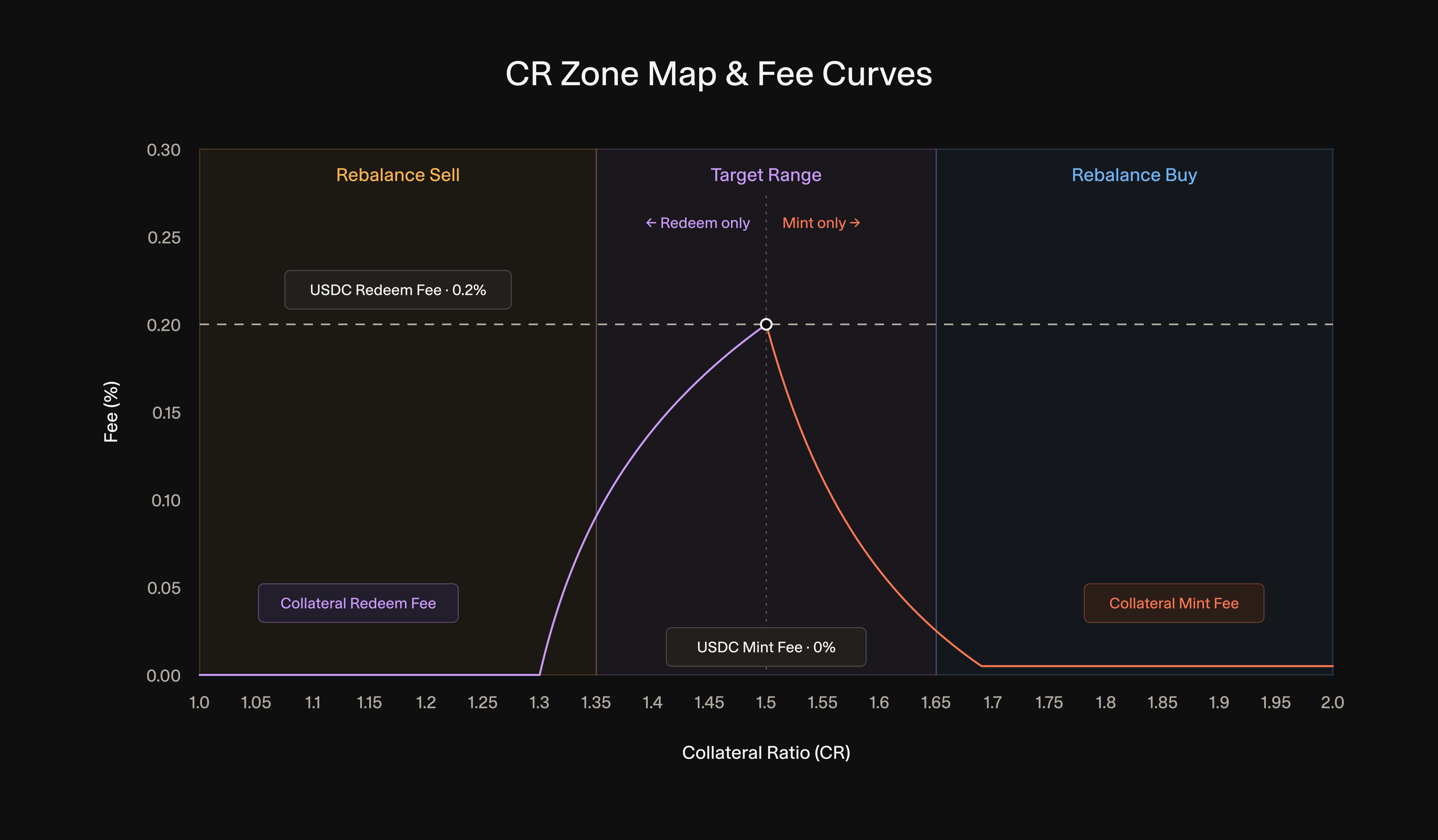
Mint Fee Curve
The mint fee curve is active when CR is above the 150% target. As the pool’s CR rises, the minting fee decreases.- At the lower bound: fee is highest
- As CR rises: fee decreases along the curve
- Above the upper bound: fee stays at its minimum, close to zero
Redeem Fee Curve
The redeem fee curve is active when CR is below the 150% target, mirroring the mint fee curve. As the pool’s CR rises, redemption fees increase.- At and below the lower bound: zero fee encouraging outflows from distressed pools
- As CR rises: fee increases along the curve
- At the upper bound (150%): fee is highest